


Faeron
Lairian
- Joined
- Feb 28, 2011
- Messages
- 34
- Points
- 24
Hello,
Long time not been here, should come here more often!
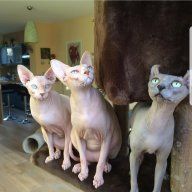
Anyhow, my name is Evy and my cat is called Sierra and together we are taking baby steps into KVV.
I don't know how it is called in English, it is called KVV here. It is ground meat frozen in rolls.
Each day you cut of a piece of the frozen roll and let it unfreeze in the fridge.
Sierra is a Sphynx (what else?) born on 3 November 2005, which means that in a month she will be 10 years old. She only comes outside on a leash and this has diminished the latest years because she just doesn't feel like going outside nor does she like the wind outside. She has Always been sensitive in feeding and this hasn't become better the last years.
The first 7/8 year she got dry kibble 24/7 with once in a while some wet food. She occassionaly had mild inflamation of the stomach, about 1 to 2 times a year. But then 2/3 years ago, she had a very severe case of stomach inflamation, it was even a close call to get her through it. But ever since she can't digest dry kibble anymore. It seems as if the kibble just builds up in her stomach until her stomach is filled up. Ever since she gets only wet food. But ever since she seems to get stomach inflamation more often, at least 2 to 3 times a year and sometimes even more. The last time her blood was checked, they found she is most probably allergic to something in her food. But what it is exactly she is allergic on is a mystery. Before then she got 1 satchel of Royal Canin Sensitivity and 3 to 4 cans of Schesir (it is like Almo). Since we know of the allergy, she gets 2 satchels of Royal Canin Sensitivity and 1 to 2 cans of Schesir. We also don't give chicken at the moment, fearing it might be chicken she is allergic on.
Another problem is that she can't eat large quantities at 1 go, because then she throws up. Because of this she gets very small portions of 15 to 20 grams a time. Do we give more, she guaranteed throws it up within 5 minutes after eating. Because of this she is of course never fully satisfied and hungry.
Because it also showed in the blood that there are some shortages, I started thinking about her food some more. Schesir wet food is not a 'complete' food, which might be the reason of the shortages in her blood. Because of this, I started thinking about raw food. Not to put her fully on it right away, but to give her as part of her food and thus preferably animals she never before ate because of her allergy.
Really raw-raw food is far too complicated for me, but here we also have KVV. In Flemisch it is 'kant en klaar vers vlees'. Translated it is 'ready raw meat'. It is sold in rolls (sausages) of 200 - 500 and 1000 grams. These rolls are frozen and you also keep them frozen. You cut of each day a portion for the next day and let it unfreeze in the fridge. For people like me who aren't up to the challenge to grind our own meat, such rolls are a good substitute. Depending on the seller, they also keep count of the percentages of muscle meat, organ meat, bone, etc.
We started with a roll of rabbit and each time a portion the size of a grain of rice. This because of the fact she only gets about 15 - 20 grams and I want to hide it in her wet food to make her eat it. If I give it to her without her wet food, she doesn't even look at it, let alone eat it. Even when mixed under her wet food, she sometimes succeeds in eating the wet food and leaving the raw food. In the meanwhile we are working on the raw food for about 2 to 3 weeks now and she gets a slightly bigger portion raw food mingled under her wet food, which for me is already a big prestation .
.
Now I do have some questions and while I don't know if there are people here who give KVV, I did want to try and ask the questions here.
1- at the moment I give Dinabarf of Dinapet. Does anyone know this brand and what do you think of it? This brand is most easy for me to get (on foot during lunch break), while other brands I have to take the car to get. But is this brand good for cats? I think it's rather new, I can't find many reviews. They have 2 tastes which are only for dogs and the others are for both dogs and cats (according to them).
The below is from their website.
QUOTE
With the productions of dinabarf we respect the barf-methode, this means that bone and organ come from the same animal.
Because of the very high nutricient value you have to give your dog less (20 to 25 gr/kilo). You will be amazed of the beautiful quality of the product as well as of the smell of the product, as if you are with the butcher in the shop.
Dinapet Barf contains very finaly ground bones (15%) and meat (70%) with some more crudely ground organs (15%) so the product remains loose and it is because of this very good to give to pups. Dinapet Barf has a natural source of calcium and no additives. A dog needs 4 kinds of meat in 4 weeks to get all necessary vitamins and minerals they need.
UNQUOTE
2- at this moment we are working with rabbit. But what kind of flavor should I introduce next? It is not for tomorrow, but in time. What is the next flavor which has the best rate of succes with cats? I had bought a roll of mix horse - rabbit - beef - fish, but now I doubt if such a mix is not too much flavors in one. So which taste should I buy next?
3- if you give raw (or in my case KVV), do you HAVE to go to only raw or is it also okay to give for example 50% wet food and 50% raw food? Also, my cat goes along on holiday with me and taking along frozen KVV seems a bit difficult when going on holiday. Is it okay to give 2 weeks only wet food when going on holiday when giving raw food at home?
Thanks already for the advice,
Evy & Sierra
Long time not been here, should come here more often!
Anyhow, my name is Evy and my cat is called Sierra and together we are taking baby steps into KVV.
I don't know how it is called in English, it is called KVV here. It is ground meat frozen in rolls.
Each day you cut of a piece of the frozen roll and let it unfreeze in the fridge.
Sierra is a Sphynx (what else?) born on 3 November 2005, which means that in a month she will be 10 years old. She only comes outside on a leash and this has diminished the latest years because she just doesn't feel like going outside nor does she like the wind outside. She has Always been sensitive in feeding and this hasn't become better the last years.
The first 7/8 year she got dry kibble 24/7 with once in a while some wet food. She occassionaly had mild inflamation of the stomach, about 1 to 2 times a year. But then 2/3 years ago, she had a very severe case of stomach inflamation, it was even a close call to get her through it. But ever since she can't digest dry kibble anymore. It seems as if the kibble just builds up in her stomach until her stomach is filled up. Ever since she gets only wet food. But ever since she seems to get stomach inflamation more often, at least 2 to 3 times a year and sometimes even more. The last time her blood was checked, they found she is most probably allergic to something in her food. But what it is exactly she is allergic on is a mystery. Before then she got 1 satchel of Royal Canin Sensitivity and 3 to 4 cans of Schesir (it is like Almo). Since we know of the allergy, she gets 2 satchels of Royal Canin Sensitivity and 1 to 2 cans of Schesir. We also don't give chicken at the moment, fearing it might be chicken she is allergic on.
Another problem is that she can't eat large quantities at 1 go, because then she throws up. Because of this she gets very small portions of 15 to 20 grams a time. Do we give more, she guaranteed throws it up within 5 minutes after eating. Because of this she is of course never fully satisfied and hungry.
Because it also showed in the blood that there are some shortages, I started thinking about her food some more. Schesir wet food is not a 'complete' food, which might be the reason of the shortages in her blood. Because of this, I started thinking about raw food. Not to put her fully on it right away, but to give her as part of her food and thus preferably animals she never before ate because of her allergy.
Really raw-raw food is far too complicated for me, but here we also have KVV. In Flemisch it is 'kant en klaar vers vlees'. Translated it is 'ready raw meat'. It is sold in rolls (sausages) of 200 - 500 and 1000 grams. These rolls are frozen and you also keep them frozen. You cut of each day a portion for the next day and let it unfreeze in the fridge. For people like me who aren't up to the challenge to grind our own meat, such rolls are a good substitute. Depending on the seller, they also keep count of the percentages of muscle meat, organ meat, bone, etc.
We started with a roll of rabbit and each time a portion the size of a grain of rice. This because of the fact she only gets about 15 - 20 grams and I want to hide it in her wet food to make her eat it. If I give it to her without her wet food, she doesn't even look at it, let alone eat it. Even when mixed under her wet food, she sometimes succeeds in eating the wet food and leaving the raw food. In the meanwhile we are working on the raw food for about 2 to 3 weeks now and she gets a slightly bigger portion raw food mingled under her wet food, which for me is already a big prestation
.Now I do have some questions and while I don't know if there are people here who give KVV, I did want to try and ask the questions here.
1- at the moment I give Dinabarf of Dinapet. Does anyone know this brand and what do you think of it? This brand is most easy for me to get (on foot during lunch break), while other brands I have to take the car to get. But is this brand good for cats? I think it's rather new, I can't find many reviews. They have 2 tastes which are only for dogs and the others are for both dogs and cats (according to them).
The below is from their website.
QUOTE
With the productions of dinabarf we respect the barf-methode, this means that bone and organ come from the same animal.
Because of the very high nutricient value you have to give your dog less (20 to 25 gr/kilo). You will be amazed of the beautiful quality of the product as well as of the smell of the product, as if you are with the butcher in the shop.
Dinapet Barf contains very finaly ground bones (15%) and meat (70%) with some more crudely ground organs (15%) so the product remains loose and it is because of this very good to give to pups. Dinapet Barf has a natural source of calcium and no additives. A dog needs 4 kinds of meat in 4 weeks to get all necessary vitamins and minerals they need.
UNQUOTE
2- at this moment we are working with rabbit. But what kind of flavor should I introduce next? It is not for tomorrow, but in time. What is the next flavor which has the best rate of succes with cats? I had bought a roll of mix horse - rabbit - beef - fish, but now I doubt if such a mix is not too much flavors in one. So which taste should I buy next?
3- if you give raw (or in my case KVV), do you HAVE to go to only raw or is it also okay to give for example 50% wet food and 50% raw food? Also, my cat goes along on holiday with me and taking along frozen KVV seems a bit difficult when going on holiday. Is it okay to give 2 weeks only wet food when going on holiday when giving raw food at home?
Thanks already for the advice,
Evy & Sierra