


Sphynxbabies
Lairian
- Joined
- Dec 8, 2022
- Messages
- 12
- Points
- 14
Hi everyone, I wanted to post my journey with my ten month old Donskoy Ambrose. When I was searching for stories from others who went through mystery rashes with their hairless cats, I was grateful to find anything that might give me a clue and make us not feel so alone in this. I have been so stressed out for my poor little guy and I really hope that one day soon we can get to the bottom of this, but here is what has happened so far.
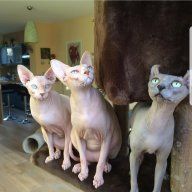
This is Ambrose. He is a ten month old Donskoy and he also has Canadian Sphynx brothers. He is the sweetest boy. All you have to do is look at him and he starts purring.

His rash started out very slight, so we initially thought maybe he was just getting a little bit too oily due to enjoying the indoor heat a little too much. The rash initially started out looking like this. As you can see, there are some bumps and also some pigmented spots, so we thought it was perhaps some form of dermatitis.

However, the rash started getting worse and worse, spreading more, and becoming more bright red.

We aren't sure if the rash actually itches him, because he doesn't scratch it. However, it is clearly stressing him out. As the rash got worse, he started urinating outside his box for the first time. He even peed in his bed. At the vet, his white blood cell count and neutrophils were high. Everything else was ok. We did skin cytology, and his skin showed a small amount of bacteria. He got an antibiotic shot and when he got home he was using the litterbox again as usual. We then scheduled a biopsy. After his biopsy, his rash was the absolute worst we have ever seen it:

So, not not only does he have a rash, but the poor little guy has a handful of sutures trying to heal. Thankfully his sutures come out tomorrow! After his biopsy, the vet put him on prednisone. It didn't have any noticeable effect. After about four days on prednisone my vet decided to try methylprednisone since it is apparently a bit stronger. He gets one pill at night. It hasn't had any effect at all. A few nights ago we rushed him to the emergency vet because we thought he was having a urinary blockage. He started peeing his bed again, so we moved another litter box downstairs. Then, he was straining over and over again and nothing came out. After hours waiting in the ER, we thankfully learned he didn't have a blockage, but had cystitis, likely from stress. Like I said, he doesn't try to itch at all, but it is clearly stressing him and causing him discomfort. He was prescribed Gabapentin twice a day and has been calm and playful with no more urinary issues. They also gave him an opioid shot at the ER which put him in an extra good mood.
The only two dermatologists around here have months and months of wait time to get in. Even the one that's an hour away can't see him until February. I have appointments made with both and I am praying we get a call that a cancellation slot opens up. In the meantime, my vet is going to discontinue the methylprednisolone and start him on Atopica. Through all my sleepless nights of searching, I have heard some good things about Atopica and I am hoping it will give him some relief.
He is also going to get on Purina hydrolyzed food. We are hoping that 8 weeks on hydrolyzed food might tell us if this is a food allergy.
Here are the results of his biopsy:
INTERPRETATION:
Hyperplastic dermatitis, mastocytic, eosinophilic and lymphohistiocytic, mild to moderate, perivascular and interstitial,
COMMENTS:
Mild to moderate chronic mastocytic and eosinophilic rich hyperplastic dermatitis is noted. Primary differentials based on the
microscopic appearance in conjunction with clinical appearance are a chronic hypersensitivity reaction or particularly in
conjunction with the clinical appearance, feline cutaneous mastocytosis. Hypersensitivity reactions are relatively nonspecific
reaction patterns which can develop secondary to dietary hypersensitivity, environmental allergens, ectoparasites including
fleas and further clinical differentiation is required. Impression cytology to further exclude a concurrent yeast and/or bacterial
infection is also advised. If hypersensitivity reaction is exhaustively excluded, cutaneous mastocytosis would be considered
the most likely differential particularly given the clinical appearance of this patient. Cutaneous mastocytosis is a diagnosis of
exclusion of other causes and it has been reported in Devon Rex and Sphynx and their crosses to date. The median age at
presentation is 15 months however the diagnosis has been made in patients ranging from 3-60 months of age. There are 3
patterns of feline cutaneous mastocytosis which cannot be distinguished from one another based upon histologic evaluation
(Polymorphic, Monomorphic and Chronic pigmented). The polymorphic form has wheals and large papules, moderate
pruritus, usually located on the front half of the body, and often regresses. The monomorphic form has erythema, macules
and papules, is generalized, has moderate pruritus and regression is less likely so long term therapy is typically needed. The
chronic pigmented form has erythema, papules, wheals, hyperpigmentation and lichenification. Pruritus is marked and
regression is less likely so long term therapy is typically needed.
I hope this information might help someone going through something similar who has been on the search for others experiences. I would also love to hear from anyone who has been on this type of journey and eventually found a solution. Ambrose is the sweetest boy, he had such beautiful skin before, and he's still just a baby, so I am hoping that this is just a hiccup with his developing immune system. I would do anything just to have him not have to suffer with this.

This is Ambrose. He is a ten month old Donskoy and he also has Canadian Sphynx brothers. He is the sweetest boy. All you have to do is look at him and he starts purring.
His rash started out very slight, so we initially thought maybe he was just getting a little bit too oily due to enjoying the indoor heat a little too much. The rash initially started out looking like this. As you can see, there are some bumps and also some pigmented spots, so we thought it was perhaps some form of dermatitis.
However, the rash started getting worse and worse, spreading more, and becoming more bright red.
We aren't sure if the rash actually itches him, because he doesn't scratch it. However, it is clearly stressing him out. As the rash got worse, he started urinating outside his box for the first time. He even peed in his bed. At the vet, his white blood cell count and neutrophils were high. Everything else was ok. We did skin cytology, and his skin showed a small amount of bacteria. He got an antibiotic shot and when he got home he was using the litterbox again as usual. We then scheduled a biopsy. After his biopsy, his rash was the absolute worst we have ever seen it:
So, not not only does he have a rash, but the poor little guy has a handful of sutures trying to heal. Thankfully his sutures come out tomorrow! After his biopsy, the vet put him on prednisone. It didn't have any noticeable effect. After about four days on prednisone my vet decided to try methylprednisone since it is apparently a bit stronger. He gets one pill at night. It hasn't had any effect at all. A few nights ago we rushed him to the emergency vet because we thought he was having a urinary blockage. He started peeing his bed again, so we moved another litter box downstairs. Then, he was straining over and over again and nothing came out. After hours waiting in the ER, we thankfully learned he didn't have a blockage, but had cystitis, likely from stress. Like I said, he doesn't try to itch at all, but it is clearly stressing him and causing him discomfort. He was prescribed Gabapentin twice a day and has been calm and playful with no more urinary issues. They also gave him an opioid shot at the ER which put him in an extra good mood.
The only two dermatologists around here have months and months of wait time to get in. Even the one that's an hour away can't see him until February. I have appointments made with both and I am praying we get a call that a cancellation slot opens up. In the meantime, my vet is going to discontinue the methylprednisolone and start him on Atopica. Through all my sleepless nights of searching, I have heard some good things about Atopica and I am hoping it will give him some relief.
He is also going to get on Purina hydrolyzed food. We are hoping that 8 weeks on hydrolyzed food might tell us if this is a food allergy.
Here are the results of his biopsy:
INTERPRETATION:
Hyperplastic dermatitis, mastocytic, eosinophilic and lymphohistiocytic, mild to moderate, perivascular and interstitial,
COMMENTS:
Mild to moderate chronic mastocytic and eosinophilic rich hyperplastic dermatitis is noted. Primary differentials based on the
microscopic appearance in conjunction with clinical appearance are a chronic hypersensitivity reaction or particularly in
conjunction with the clinical appearance, feline cutaneous mastocytosis. Hypersensitivity reactions are relatively nonspecific
reaction patterns which can develop secondary to dietary hypersensitivity, environmental allergens, ectoparasites including
fleas and further clinical differentiation is required. Impression cytology to further exclude a concurrent yeast and/or bacterial
infection is also advised. If hypersensitivity reaction is exhaustively excluded, cutaneous mastocytosis would be considered
the most likely differential particularly given the clinical appearance of this patient. Cutaneous mastocytosis is a diagnosis of
exclusion of other causes and it has been reported in Devon Rex and Sphynx and their crosses to date. The median age at
presentation is 15 months however the diagnosis has been made in patients ranging from 3-60 months of age. There are 3
patterns of feline cutaneous mastocytosis which cannot be distinguished from one another based upon histologic evaluation
(Polymorphic, Monomorphic and Chronic pigmented). The polymorphic form has wheals and large papules, moderate
pruritus, usually located on the front half of the body, and often regresses. The monomorphic form has erythema, macules
and papules, is generalized, has moderate pruritus and regression is less likely so long term therapy is typically needed. The
chronic pigmented form has erythema, papules, wheals, hyperpigmentation and lichenification. Pruritus is marked and
regression is less likely so long term therapy is typically needed.
I hope this information might help someone going through something similar who has been on the search for others experiences. I would also love to hear from anyone who has been on this type of journey and eventually found a solution. Ambrose is the sweetest boy, he had such beautiful skin before, and he's still just a baby, so I am hoping that this is just a hiccup with his developing immune system. I would do anything just to have him not have to suffer with this.