


- Joined
- Dec 19, 2010
- Messages
- 6,201
- Points
- 643
This is from Cornell University of Veterinary Medicine.
I know it is long but is good start.
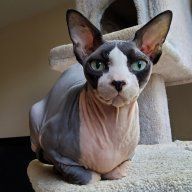
(When my sphynx Ki was diagnosed with severe food allergies. She did well on a rabbit diet. We had to have no poultry or beef. She could do venison and elk also. But, I would suggest you start with only one protein at a time. Add only another in when you are sure Fisen is not reacting to the current protein being fed. It took me awhile to get her regulated but we did it and he lived symptom free for a long time. She was also on a low dose oral steriod. )
Food Allergies
Studies have shown that food allergies overall are the third most common type of feline allergy, outranked in frequency only by allergies to flea bites and inhaled substances. Although itchy, irritating skin problems are the most common signs of this allergy, an estimated 10 percent to 15 percent of affected cats also exhibit gastrointestinal signs, such as vomiting and diarrhea.
The itching that typically signals the presence of a food allergy is caused by the eruption of small, pale, fluid-filled lumps on a cat’s skin, which form in response to the presence of an allergen, a substance to which the animal’s system is abnormally sensitive.
“The itching eruptions primarily affect the head and neck area,” says Carolyn McDaniel, VMD, a lecturer in clinical sciences at Cornell University’s College of Veterinary Medicine. “They’re not always in that area, but often enough to serve as a clue that the source is a food allergy.”
In themselves, the aggravating lesions do not pose a significant health hazard. But the incessant scratching that they prompt may cause secondary skin wounds and a resulting vulnerability to severe bacterial infection. In addition, gastrointestinal problems stemming from a food allergy may have far-reaching systemic implications, including food avoidance that can result in health-compromising weight loss.
The most visible signs of a food allergy—the persistent scratching, the emergence of skin lesions, loss of hair, and a general deterioration of the coat—do not develop overnight. Instead, they tend to become evident and intensify over extended periods of time—months or even longer—as the animal’s immune system gradually mounts a defense against certain protein and carbohydrate molecules that are present in most standard cat foods. “We don’t know why this allergy develops,” says Dr. McDaniel. “A cat of any age can be affected, and it can occur in a cat that has been on the same diet for years.”
When the signs appear, a cat should receive prompt veterinary care. If a food allergy is indeed suspected, the specific allergen should be identified and removed from the animal’s diet.
After other potential causes of the skin eruptions, such as flea bites, are ruled out and a food allergy is identified as the probable cause of the clinical signs, the next challenge is to identify what precisely in the cat’s diet is responsible for the problem. This process will most effectively be carried out at home by the owner’s introduction of what is termed a “novel” diet, which is based on the fact that most feline food allergies are traceable to the protein or carbohydrate content of an affected animal’s normal fare.
The most commonly used protein sources in cat food include beef, pork, lamb, chicken, turkey, and eggs. Since protein is a fundamental component of living cells and is necessary for the proper functioning of an organism, the novel diet must contain protein—but it must be derived from a source to which an affected cat has not been previously exposed, such as venison or kangaroo meat. Since the same holds true for carbohydrates, the vegetables that are frequently used in cat foods—wheat, barley, and corn, for instance—would be excluded from the novel diet and replaced by, for example, potato.
If a cat consumes nothing but the novel diet and water for a period of at least eight to 10 weeks, it is likely that the allergic signs will gradually disappear. In that case, the owner can assume that the allergen was a component of the previous diet. And to identify the specific offending allergen, the owner subsequently reintroduces components of the cat’s original diet one by one and watches carefully for the reemergence of allergic symptoms. If the symptoms recur, they will probably do so within a week or two, in which case the owner will have confirmed at least one source of the allergy.
Through repeated systematic testing—and a lot of patience—it is possible for the owner to pinpoint all dietary ingredients to which a cat is allergic. Therapy, it follows, requires the permanent exclusion of these ingredients from the cat’s diet