Welcome to Sphynxlair! Connect with Sphynx owners & enthusiasts around the world!
Navigation
Install the app
How to install the app on iOS
Follow along with the video below to see how to install our site as a web app on your home screen.
Note: This feature may not be available in some browsers.
More options
You are using an out of date browser. It may not display this or other websites correctly.
You should upgrade or use an alternative browser.
You should upgrade or use an alternative browser.
Determining Markings: Names & Pics
- Thread starter NekkidIzUs
- Start date

holly_savage
Banned
- Joined
- Mar 6, 2010
- Messages
- 1,229
- Points
- 0

- Joined
- Aug 23, 2009
- Messages
- 13,556
- Points
- 673
I have saved this link, someone else posted it somewhere. The drawings are crude / basic, but I found it to be very helpful in explaining the different patterns / colors and their relation to eye color and the such...
Drawing Cats 6: Guide to coat colors and patterns
I finally got a chance to look at this--the other day the link wouldn't work. Thanks so much for posting this Holly, I had never seen it before....and it's helpful.


- Joined
- Jan 2, 2011
- Messages
- 890
- Points
- 168
I didn't have a chance to read thru all these posts but came across some info today...
SPHYNX COLORS
GENERAL: all colors and patterns, in any combination, found in felines is acceptable.
WHITE: white to pink. Nose leather and paw pads: pink.
BLACK: black. One level tone from nose to tip of tail. Nose leather: black. Paw pads: black or brown.
BLUE: blue. One level tone from nose to tip of tail. Nose leather and paw pads: blue.
RED: deep, rich, clear, brilliant red, without markings. Lips and chin the same color as the skin. Nose leather and paw pads: brick red.
CHOCOLATE: rich chestnut brown, even throughout. Nose leather: brown. Paw pads: brown or cinnamon.
LAVENDER:frosty-grey with a pinkish tone, even throughout. Nose leather and paw pads: lavender-pink.
CINNAMON: cinnamon, even throughout. Nose leather and paw pads: cinnamon.
FAWN: pale, pinkish fawn, even throughout. Nose leather and paw pads: pale fawn.
CLASSIC TABBY PATTERN: markings clearly defined on legs and tail. Pattern tends to fade on hairless body. Legs evenly barred with bracelets coming up to meet the body markings. Tail evenly ringed. Several unbroken necklaces on neck and upper chest, the more the better. Markings seen on the skin. Frown lines on head form an intricate letter "M" Unbroken line runs back from outer corner of eye. Swirls on cheeks. Vertical lines over back of head extend to shoulder markings which are in the shape of a butterfly with both upper and lower wings distinctly outlined and marked with dots inside outline. Back markings consist of a vertical line down the spine from butterfly to tail with a vertical stripe paralleling it on each side, the three stripes well separated by stripes of the ground color. Large solid blotch on each side to be encircled by one or more unbroken rings. Side markings should be the same on both sides. Double vertical rows of buttons on chest and stomach.
MACKEREL TABBY PATTERN: markings clearly defined on legs and tail. Pattern tends to fade on hairless body. Legs evenly barred with narrow bracelets coming up to meet the body markings. Tail barred. Necklaces on neck and chest distinct, like so many chains. Head barred with an "M" on the forehead. Unbroken lines running back from the eyes. Lines running down the head to meet the shoulders. Spine lines run together to form a narrow saddle. Narrow pencillings run around body.
SPOTTED TABBY PATTERN: markings on the body to be spotted. The spots can be round, oblong, or rosette-shaped. Any of these are of equal merit but the spots, however shaped or placed, shall be distinct. Spots should not run together in a broken Mackerel pattern. A dorsal stripe runs the length of the body to the tip of the tail. The stripe is ideally composed of spots. The markings on the face and forehead shall be typically tabby markings. Underside of the body to have "vest buttons." Legs and tail are barred. Markings clearly defined on legs and tail. Pattern tends to fade on hairless body.
BROWN TABBY: skin ground color brilliant coppery brown. Markings dense black. Lips and chin the same shade as the rings around the eyes. Back of leg black from paw to heel. Nose leather: brick red. Paw pads: black or brown.
BLUE TABBY: skin ground color, including lips and chin, pale bluish ivory. Markings a very deep blue affording a good contrast with skin ground color. Nose leather: old rose. Paw pads: rose.
RED TABBY: skin ground color red. Markings deep, rich red. Lips and chin red. Nose leather and paw pads: brick red.
CREAM TABBY: skin ground color, including lips and chin, very pale cream. Markings buff or cream sufficiently darker than the ground color to afford good contrast but remaining within the dilute color range. Nose leather and paw pads: pink.
CHOCOLATE (Chestnut) TABBY: skin ground color is warm fawn, markings are rich chestnut brown. Nose leather: chestnut, or pink rimmed with chestnut. Paw pads: cinnamon.
CHOCOLATE-SILVER TABBY: skin ground color, including lips and chin, is silver. Markings rich chestnut. Nose leather: chestnut or pink rimmed with chestnut. Paw pads: cinnamon.
CINNAMON TABBY: skin ground color, including lips and chin, a pale, warm honey, markings a dense cinnamon, affording a good contrast with skin ground color. Nose leather: cinnamon or coral rimmed with cinnamon. Paw pads: cinnamon.
CINNAMON-SILVER TABBY: skin ground color, including lips and chin, a pale glistening silver. Markings dense cinnamon. Nose leather: cinnamon. Paw pads: coral.
LAVENDER TABBY: skin ground color is pale lavender. Markings are a rich lavender, affording a good contrast with skin ground color. Nose leather: lavender, or pink rimmed with lavender. Paw pads: lavender-pink.
LAVENDER-SILVER TABBY: skin ground color, including lips and chin, a cold clear silver. Markings lavender. Nose leather: lavender or pink rimmed with lavender. Paw pads: lavender-pink.
FAWN TABBY: skin ground color, including lips and chin, pale ivory, markings dense fawn, affording good contrast with skin ground color. Nose leather and paw pads: pale fawn.
TORTOISESHELL: black mottled or patched with red and/or cream. Blaze on face desirable.
BLUE-CREAM: blue mottled or patched with cream. Blaze on face desirable.
CHOCOLATE (Chestnut) TORTOISESHELL: rich chestnut brown mottled or patched with red and/or cream. Blaze on face desirable.
CINNAMON TORTOISESHELL: cinnamon mottled or patched with red and/or cream. Blaze on face desirable.
LAVENDER-CREAM: lavender mottled or patched with cream. Blaze on face desirable.
FAWN-CREAM: fawn mottled or patched with cream. Blaze on face desirable.
CALICO: white with unbrindled patches of black and red. White predominant on underparts.
VAN CALICO: white with unbrindled patches of black and red confined to the extremities; head, tail, legs. One or two small patches of color on body allowable.
DILUTE CALICO: white with unbrindled patches of blue and cream. White predominant on underparts.
DILUTE VAN CALICO: white with unbrindled patches of blue and cream confined to the extremities; head, tail, legs. One or two small patches of color on body allowable.
BI-COLOR: solid color and white, tabby and white, tortoiseshell and white, pointed and white, any color and white, etc.
VAN BI-COLOR: solid color and white, tabby and white, tortoiseshell and white, etc., with color confined to the extremities; head, tail, and legs. One or two small patches on body allowable.
FAWN CALICO, LAVENDER CALICO, CINNAMON CALICO, CHOCOLATE CALICO: as for calico above, with appropriate marking color.
POINTED PATTERN: point restricted colors show little or no color contrast between body and points in the mature Sphynx. Although born very light in color, the pointed Sphynx will darken and appear solid in color as an adult. Eye color: vivid blue. Nose leather and paw pads: appropriate to coat color. The pointed pattern may be combined with ANY other pattern (except mink) and ANY colors, e.g. lilac-silver lynx point and seal-tortie point with white (shown in the Bi-Color Class).
MINK PATTERN: point restricted colors show little or no color differentiation between body and points in the mature Sphynx. Although born very light in color, the mink Sphynx will darken and appear solid in color as an adult. Eye color: aqua. Nose leather and paw pads: appropriate to coat color. The mink pattern may be combined with ANY other pattern (except pointed) and ANY colors, e.g. natural mink, blue mink, champagne mink, platinum mink, natural tabby mink, blue-cream, tortie mink and white (shown in Bi-Color Class).
SABLE: the mature specimen is a rich, warm, sable brown without shadings, barring, or markings of any kind. (Kittens are often lighter in color.) Nose leather and paw pads: brown.
CHAMPAGNE: the mature specimen should be a warm honey beige without shadings, barring, or markings of any kind. Nose leather: light, warm brown. Paw pads: warm, pinkish tan.
PLATINUM: the mature specimen should be a pale, silvery gray without shadings, barring or markings of any kind. Nose leather and paw pads: lavender-pink.
OSC (Other Sphynx Colors): any other color or pattern. Cats with no more than a locket and/or button do not qualify for this class, such cats shall be judged in the color class of their basic color with no penalty for such locket and/or button. Examples: any color with one, two, three, or four white feet. All point restricted colors such as seal point, chocolate point, natural mink, blue mink, sable, champagne, platinum, etc.
SPHYNX COLORS
GENERAL: all colors and patterns, in any combination, found in felines is acceptable.
WHITE: white to pink. Nose leather and paw pads: pink.
BLACK: black. One level tone from nose to tip of tail. Nose leather: black. Paw pads: black or brown.
BLUE: blue. One level tone from nose to tip of tail. Nose leather and paw pads: blue.
RED: deep, rich, clear, brilliant red, without markings. Lips and chin the same color as the skin. Nose leather and paw pads: brick red.
CREAM:
one level shade of buff cream, without markings. Nose leather and paw pads: pink.CHOCOLATE: rich chestnut brown, even throughout. Nose leather: brown. Paw pads: brown or cinnamon.
LAVENDER:frosty-grey with a pinkish tone, even throughout. Nose leather and paw pads: lavender-pink.
CINNAMON: cinnamon, even throughout. Nose leather and paw pads: cinnamon.
FAWN: pale, pinkish fawn, even throughout. Nose leather and paw pads: pale fawn.
CLASSIC TABBY PATTERN: markings clearly defined on legs and tail. Pattern tends to fade on hairless body. Legs evenly barred with bracelets coming up to meet the body markings. Tail evenly ringed. Several unbroken necklaces on neck and upper chest, the more the better. Markings seen on the skin. Frown lines on head form an intricate letter "M" Unbroken line runs back from outer corner of eye. Swirls on cheeks. Vertical lines over back of head extend to shoulder markings which are in the shape of a butterfly with both upper and lower wings distinctly outlined and marked with dots inside outline. Back markings consist of a vertical line down the spine from butterfly to tail with a vertical stripe paralleling it on each side, the three stripes well separated by stripes of the ground color. Large solid blotch on each side to be encircled by one or more unbroken rings. Side markings should be the same on both sides. Double vertical rows of buttons on chest and stomach.
MACKEREL TABBY PATTERN: markings clearly defined on legs and tail. Pattern tends to fade on hairless body. Legs evenly barred with narrow bracelets coming up to meet the body markings. Tail barred. Necklaces on neck and chest distinct, like so many chains. Head barred with an "M" on the forehead. Unbroken lines running back from the eyes. Lines running down the head to meet the shoulders. Spine lines run together to form a narrow saddle. Narrow pencillings run around body.
SPOTTED TABBY PATTERN: markings on the body to be spotted. The spots can be round, oblong, or rosette-shaped. Any of these are of equal merit but the spots, however shaped or placed, shall be distinct. Spots should not run together in a broken Mackerel pattern. A dorsal stripe runs the length of the body to the tip of the tail. The stripe is ideally composed of spots. The markings on the face and forehead shall be typically tabby markings. Underside of the body to have "vest buttons." Legs and tail are barred. Markings clearly defined on legs and tail. Pattern tends to fade on hairless body.
PATCHED TABBY PATTERN:
a patched tabby (torbie) is an established silver, brown, blue, lavender, fawn, cinnamon or chocolate tabby with patches of red or cream clearly defined on both the body and extremities; a blaze on the face is desirable.SILVER TABBY:
skin ground color, including lips and chin, pale clear silver. Markings dense black. Nose leather: brick red. Paw pads: black.BROWN TABBY: skin ground color brilliant coppery brown. Markings dense black. Lips and chin the same shade as the rings around the eyes. Back of leg black from paw to heel. Nose leather: brick red. Paw pads: black or brown.
BLUE TABBY: skin ground color, including lips and chin, pale bluish ivory. Markings a very deep blue affording a good contrast with skin ground color. Nose leather: old rose. Paw pads: rose.
RED TABBY: skin ground color red. Markings deep, rich red. Lips and chin red. Nose leather and paw pads: brick red.
CREAM TABBY: skin ground color, including lips and chin, very pale cream. Markings buff or cream sufficiently darker than the ground color to afford good contrast but remaining within the dilute color range. Nose leather and paw pads: pink.
CHOCOLATE (Chestnut) TABBY: skin ground color is warm fawn, markings are rich chestnut brown. Nose leather: chestnut, or pink rimmed with chestnut. Paw pads: cinnamon.
CHOCOLATE-SILVER TABBY: skin ground color, including lips and chin, is silver. Markings rich chestnut. Nose leather: chestnut or pink rimmed with chestnut. Paw pads: cinnamon.
CINNAMON TABBY: skin ground color, including lips and chin, a pale, warm honey, markings a dense cinnamon, affording a good contrast with skin ground color. Nose leather: cinnamon or coral rimmed with cinnamon. Paw pads: cinnamon.
CINNAMON-SILVER TABBY: skin ground color, including lips and chin, a pale glistening silver. Markings dense cinnamon. Nose leather: cinnamon. Paw pads: coral.
LAVENDER TABBY: skin ground color is pale lavender. Markings are a rich lavender, affording a good contrast with skin ground color. Nose leather: lavender, or pink rimmed with lavender. Paw pads: lavender-pink.
LAVENDER-SILVER TABBY: skin ground color, including lips and chin, a cold clear silver. Markings lavender. Nose leather: lavender or pink rimmed with lavender. Paw pads: lavender-pink.
FAWN TABBY: skin ground color, including lips and chin, pale ivory, markings dense fawn, affording good contrast with skin ground color. Nose leather and paw pads: pale fawn.
TORTOISESHELL: black mottled or patched with red and/or cream. Blaze on face desirable.
BLUE-CREAM: blue mottled or patched with cream. Blaze on face desirable.
CHOCOLATE (Chestnut) TORTOISESHELL: rich chestnut brown mottled or patched with red and/or cream. Blaze on face desirable.
CINNAMON TORTOISESHELL: cinnamon mottled or patched with red and/or cream. Blaze on face desirable.
LAVENDER-CREAM: lavender mottled or patched with cream. Blaze on face desirable.
FAWN-CREAM: fawn mottled or patched with cream. Blaze on face desirable.
CALICO: white with unbrindled patches of black and red. White predominant on underparts.
VAN CALICO: white with unbrindled patches of black and red confined to the extremities; head, tail, legs. One or two small patches of color on body allowable.
DILUTE CALICO: white with unbrindled patches of blue and cream. White predominant on underparts.
DILUTE VAN CALICO: white with unbrindled patches of blue and cream confined to the extremities; head, tail, legs. One or two small patches of color on body allowable.
BI-COLOR: solid color and white, tabby and white, tortoiseshell and white, pointed and white, any color and white, etc.
VAN BI-COLOR: solid color and white, tabby and white, tortoiseshell and white, etc., with color confined to the extremities; head, tail, and legs. One or two small patches on body allowable.
FAWN CALICO, LAVENDER CALICO, CINNAMON CALICO, CHOCOLATE CALICO: as for calico above, with appropriate marking color.
FAWN VAN CALICO, LAVENDER VAN CALICO, CINNAMON VAN CALICO, CHOCOLATE VAN CALICO:
as for van calico labove, with appropriate marking color.POINTED PATTERN: point restricted colors show little or no color contrast between body and points in the mature Sphynx. Although born very light in color, the pointed Sphynx will darken and appear solid in color as an adult. Eye color: vivid blue. Nose leather and paw pads: appropriate to coat color. The pointed pattern may be combined with ANY other pattern (except mink) and ANY colors, e.g. lilac-silver lynx point and seal-tortie point with white (shown in the Bi-Color Class).
MINK PATTERN: point restricted colors show little or no color differentiation between body and points in the mature Sphynx. Although born very light in color, the mink Sphynx will darken and appear solid in color as an adult. Eye color: aqua. Nose leather and paw pads: appropriate to coat color. The mink pattern may be combined with ANY other pattern (except pointed) and ANY colors, e.g. natural mink, blue mink, champagne mink, platinum mink, natural tabby mink, blue-cream, tortie mink and white (shown in Bi-Color Class).
SABLE: the mature specimen is a rich, warm, sable brown without shadings, barring, or markings of any kind. (Kittens are often lighter in color.) Nose leather and paw pads: brown.
CHAMPAGNE: the mature specimen should be a warm honey beige without shadings, barring, or markings of any kind. Nose leather: light, warm brown. Paw pads: warm, pinkish tan.
PLATINUM: the mature specimen should be a pale, silvery gray without shadings, barring or markings of any kind. Nose leather and paw pads: lavender-pink.
OSC (Other Sphynx Colors): any other color or pattern. Cats with no more than a locket and/or button do not qualify for this class, such cats shall be judged in the color class of their basic color with no penalty for such locket and/or button. Examples: any color with one, two, three, or four white feet. All point restricted colors such as seal point, chocolate point, natural mink, blue mink, sable, champagne, platinum, etc.
Last edited:
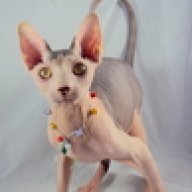
- Joined
- Mar 28, 2011
- Messages
- 4,814
- Points
- 338
I didn't have a chance to read thru all these posts but came across some info today...
SPHYNX COLORS
GENERAL: all colors and patterns, in any combination, found in felines is acceptable.
WHITE: white to pink. Nose leather and paw pads: pink.
BLACK: black. One level tone from nose to tip of tail. Nose leather: black. Paw pads: black or brown.
BLUE: blue. One level tone from nose to tip of tail. Nose leather and paw pads: blue.
RED: deep, rich, clear, brilliant red, without markings. Lips and chin the same color as the skin. Nose leather and paw pads: brick red.
CREAM:one level shade of buff cream, without markings. Nose leather and paw pads: pink.
CHOCOLATE: rich chestnut brown, even throughout. Nose leather: brown. Paw pads: brown or cinnamon.
LAVENDER:frosty-grey with a pinkish tone, even throughout. Nose leather and paw pads: lavender-pink.
CINNAMON: cinnamon, even throughout. Nose leather and paw pads: cinnamon.
FAWN: pale, pinkish fawn, even throughout. Nose leather and paw pads: pale fawn.
CLASSIC TABBY PATTERN: markings clearly defined on legs and tail. Pattern tends to fade on hairless body. Legs evenly barred with bracelets coming up to meet the body markings. Tail evenly ringed. Several unbroken necklaces on neck and upper chest, the more the better. Markings seen on the skin. Frown lines on head form an intricate letter "M" Unbroken line runs back from outer corner of eye. Swirls on cheeks. Vertical lines over back of head extend to shoulder markings which are in the shape of a butterfly with both upper and lower wings distinctly outlined and marked with dots inside outline. Back markings consist of a vertical line down the spine from butterfly to tail with a vertical stripe paralleling it on each side, the three stripes well separated by stripes of the ground color. Large solid blotch on each side to be encircled by one or more unbroken rings. Side markings should be the same on both sides. Double vertical rows of buttons on chest and stomach.
MACKEREL TABBY PATTERN: markings clearly defined on legs and tail. Pattern tends to fade on hairless body. Legs evenly barred with narrow bracelets coming up to meet the body markings. Tail barred. Necklaces on neck and chest distinct, like so many chains. Head barred with an "M" on the forehead. Unbroken lines running back from the eyes. Lines running down the head to meet the shoulders. Spine lines run together to form a narrow saddle. Narrow pencillings run around body.
SPOTTED TABBY PATTERN: markings on the body to be spotted. The spots can be round, oblong, or rosette-shaped. Any of these are of equal merit but the spots, however shaped or placed, shall be distinct. Spots should not run together in a broken Mackerel pattern. A dorsal stripe runs the length of the body to the tip of the tail. The stripe is ideally composed of spots. The markings on the face and forehead shall be typically tabby markings. Underside of the body to have "vest buttons." Legs and tail are barred. Markings clearly defined on legs and tail. Pattern tends to fade on hairless body.
PATCHED TABBY PATTERN:a patched tabby (torbie) is an established silver, brown, blue, lavender, fawn, cinnamon or chocolate tabby with patches of red or cream clearly defined on both the body and extremities; a blaze on the face is desirable.
SILVER TABBY:skin ground color, including lips and chin, pale clear silver. Markings dense black. Nose leather: brick red. Paw pads: black.
BROWN TABBY: skin ground color brilliant coppery brown. Markings dense black. Lips and chin the same shade as the rings around the eyes. Back of leg black from paw to heel. Nose leather: brick red. Paw pads: black or brown.
BLUE TABBY: skin ground color, including lips and chin, pale bluish ivory. Markings a very deep blue affording a good contrast with skin ground color. Nose leather: old rose. Paw pads: rose.
RED TABBY: skin ground color red. Markings deep, rich red. Lips and chin red. Nose leather and paw pads: brick red.
CREAM TABBY: skin ground color, including lips and chin, very pale cream. Markings buff or cream sufficiently darker than the ground color to afford good contrast but remaining within the dilute color range. Nose leather and paw pads: pink.
CHOCOLATE (Chestnut) TABBY: skin ground color is warm fawn, markings are rich chestnut brown. Nose leather: chestnut, or pink rimmed with chestnut. Paw pads: cinnamon.
CHOCOLATE-SILVER TABBY: skin ground color, including lips and chin, is silver. Markings rich chestnut. Nose leather: chestnut or pink rimmed with chestnut. Paw pads: cinnamon.
CINNAMON TABBY: skin ground color, including lips and chin, a pale, warm honey, markings a dense cinnamon, affording a good contrast with skin ground color. Nose leather: cinnamon or coral rimmed with cinnamon. Paw pads: cinnamon.
CINNAMON-SILVER TABBY: skin ground color, including lips and chin, a pale glistening silver. Markings dense cinnamon. Nose leather: cinnamon. Paw pads: coral.
LAVENDER TABBY: skin ground color is pale lavender. Markings are a rich lavender, affording a good contrast with skin ground color. Nose leather: lavender, or pink rimmed with lavender. Paw pads: lavender-pink.
LAVENDER-SILVER TABBY: skin ground color, including lips and chin, a cold clear silver. Markings lavender. Nose leather: lavender or pink rimmed with lavender. Paw pads: lavender-pink.
FAWN TABBY: skin ground color, including lips and chin, pale ivory, markings dense fawn, affording good contrast with skin ground color. Nose leather and paw pads: pale fawn.
TORTOISESHELL: black mottled or patched with red and/or cream. Blaze on face desirable.
BLUE-CREAM: blue mottled or patched with cream. Blaze on face desirable.
CHOCOLATE (Chestnut) TORTOISESHELL: rich chestnut brown mottled or patched with red and/or cream. Blaze on face desirable.
CINNAMON TORTOISESHELL: cinnamon mottled or patched with red and/or cream. Blaze on face desirable.
LAVENDER-CREAM: lavender mottled or patched with cream. Blaze on face desirable.
FAWN-CREAM: fawn mottled or patched with cream. Blaze on face desirable.
CALICO: white with unbrindled patches of black and red. White predominant on underparts.
VAN CALICO: white with unbrindled patches of black and red confined to the extremities; head, tail, legs. One or two small patches of color on body allowable.
DILUTE CALICO: white with unbrindled patches of blue and cream. White predominant on underparts.
DILUTE VAN CALICO: white with unbrindled patches of blue and cream confined to the extremities; head, tail, legs. One or two small patches of color on body allowable.
BI-COLOR: solid color and white, tabby and white, tortoiseshell and white, pointed and white, any color and white, etc.
VAN BI-COLOR: solid color and white, tabby and white, tortoiseshell and white, etc., with color confined to the extremities; head, tail, and legs. One or two small patches on body allowable.
FAWN CALICO, LAVENDER CALICO, CINNAMON CALICO, CHOCOLATE CALICO: as for calico above, with appropriate marking color.
FAWN VAN CALICO, LAVENDER VAN CALICO, CINNAMON VAN CALICO, CHOCOLATE VAN CALICO:as for van calico labove, with appropriate marking color.
POINTED PATTERN: point restricted colors show little or no color contrast between body and points in the mature Sphynx. Although born very light in color, the pointed Sphynx will darken and appear solid in color as an adult. Eye color: vivid blue. Nose leather and paw pads: appropriate to coat color. The pointed pattern may be combined with ANY other pattern (except mink) and ANY colors, e.g. lilac-silver lynx point and seal-tortie point with white (shown in the Bi-Color Class).
MINK PATTERN: point restricted colors show little or no color differentiation between body and points in the mature Sphynx. Although born very light in color, the mink Sphynx will darken and appear solid in color as an adult. Eye color: aqua. Nose leather and paw pads: appropriate to coat color. The mink pattern may be combined with ANY other pattern (except pointed) and ANY colors, e.g. natural mink, blue mink, champagne mink, platinum mink, natural tabby mink, blue-cream, tortie mink and white (shown in Bi-Color Class).
SABLE: the mature specimen is a rich, warm, sable brown without shadings, barring, or markings of any kind. (Kittens are often lighter in color.) Nose leather and paw pads: brown.
CHAMPAGNE: the mature specimen should be a warm honey beige without shadings, barring, or markings of any kind. Nose leather: light, warm brown. Paw pads: warm, pinkish tan.
PLATINUM: the mature specimen should be a pale, silvery gray without shadings, barring or markings of any kind. Nose leather and paw pads: lavender-pink.
OSC (Other Sphynx Colors): any other color or pattern. Cats with no more than a locket and/or button do not qualify for this class, such cats shall be judged in the color class of their basic color with no penalty for such locket and/or button. Examples: any color with one, two, three, or four white feet. All point restricted colors such as seal point, chocolate point, natural mink, blue mink, sable, champagne, platinum, etc.
Wow, all the coloring info in a nutshell! Great post!


- Joined
- Apr 9, 2011
- Messages
- 352
- Points
- 123
Wow, all the coloring info in a nutshell! Great post!
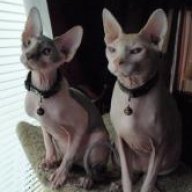
So is Fiona a Van Bi Color or just Bi color? she is white & only has black on the tail and head, which it mentions on the Van Bi color.
I didn't see tuxedo? Is swindle another color and I've been wrong calling him Tuxedo?
Help!

- Joined
- Feb 15, 2011
- Messages
- 1,209
- Points
- 0
So is Fiona a Van Bi Color or just Bi color? she is white & only has black on the tail and head, which it mentions on the Van Bi color.
I didn't see tuxedo? Is swindle another color and I've been wrong calling him Tuxedo?
Help!
Okay let me see... Tux is a marking not a color, so thats why you didn't see that......He does look like a tux to me....
I cant tell the other from the tiny pic...To be a Van she would need 3 colors..To be Bi color she would only need two.....example ... Van would be red,black and white....Bi would be black and white, with no red(the third color).........I THINK........

- Joined
- Apr 9, 2011
- Messages
- 352
- Points
- 123
Okay let me see... Tux is a marking not a color, so thats why you didn't see that......He does look like a tux to me....
I cant tell the other from the tiny pic...To be a Van she would need 3 colors..To be Bi color she would only need two.....example ... Van would be red,black and white....Bi would be black and white, with no red(the third color).........I THINK........
Thanks! Then I think they are both bi color, and Swindle is just a bi color tuxedo pattern Sphynx! Now I know. When I asked the lady I got them from she said Fiona was pink flesh colored. I knew that was not the offical color.

- Joined
- Mar 28, 2011
- Messages
- 4,814
- Points
- 338
So is Fiona a Van Bi Color or just Bi color? she is white & only has black on the tail and head, which it mentions on the Van Bi color.
I didn't see tuxedo? Is swindle another color and I've been wrong calling him Tuxedo?
Help!
Looks like a tuxedo (blk & wht). Not sure about your other 2.
- Joined
- Apr 1, 2011
- Messages
- 5,411
- Points
- 393
This is great! My breeder explained to me that points will always have blue eyes and a mink will have aqua eyes.... also a white will be bright white and a cream will be a peachy color. Tabby and tux are patterns. Many domestic cats are tabby and in general persians, rag dolls and siamese have points and blue eyes.
Mine are far too young to tell real color yet but Diggs is a chocolate tabby mink, although I.can't see his stripes.... and his eyes haven't changed.....

Oz is a green eyed white, he will get brighter as he grows

And Lyle is a lilac or lavender and white.... the breeder doesn't know what he will look like though, I believe this is the momas first litter, mom is lilac and white mink and dad is an odd eye white.

All of the boys have the same daddy, Oz and Diggs are from the same litter.
Mine are far too young to tell real color yet but Diggs is a chocolate tabby mink, although I.can't see his stripes.... and his eyes haven't changed.....
Oz is a green eyed white, he will get brighter as he grows
And Lyle is a lilac or lavender and white.... the breeder doesn't know what he will look like though, I believe this is the momas first litter, mom is lilac and white mink and dad is an odd eye white.
All of the boys have the same daddy, Oz and Diggs are from the same litter.
- Joined
- Mar 28, 2011
- Messages
- 4,814
- Points
- 338
Now, Oz & Diggs will come home 1st, right? They are older than Lyle. How many weeks more will it be before he comes home? Gosh, ur so lucky to have 3. It would be super perfect if they all liked taking baths. You could just put them all in the tub @ the same time to play & just wash 1 @ a time. Just think, 6 ears to clean & 20 nails to clip & clean. Be sure your nail clipper is sharp
Be sure your nail clipper is sharp
- Joined
- Feb 24, 2011
- Messages
- 763
- Points
- 138
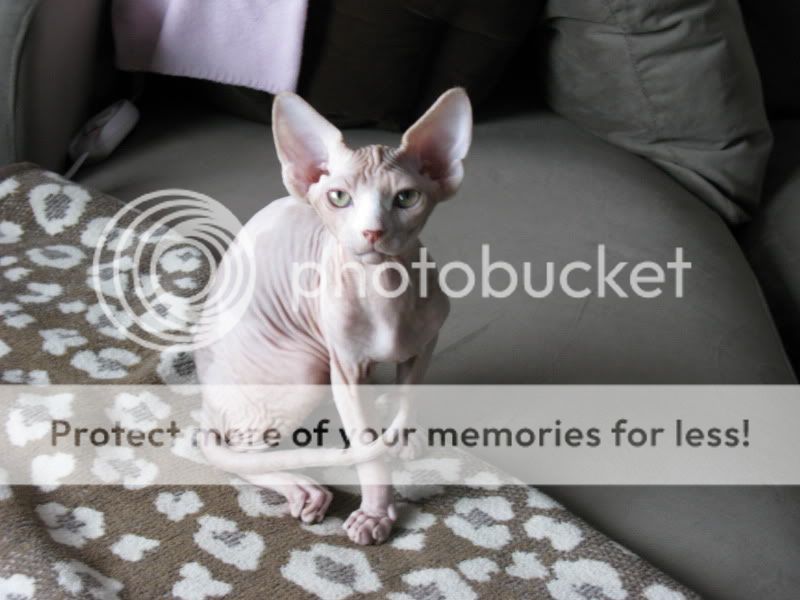
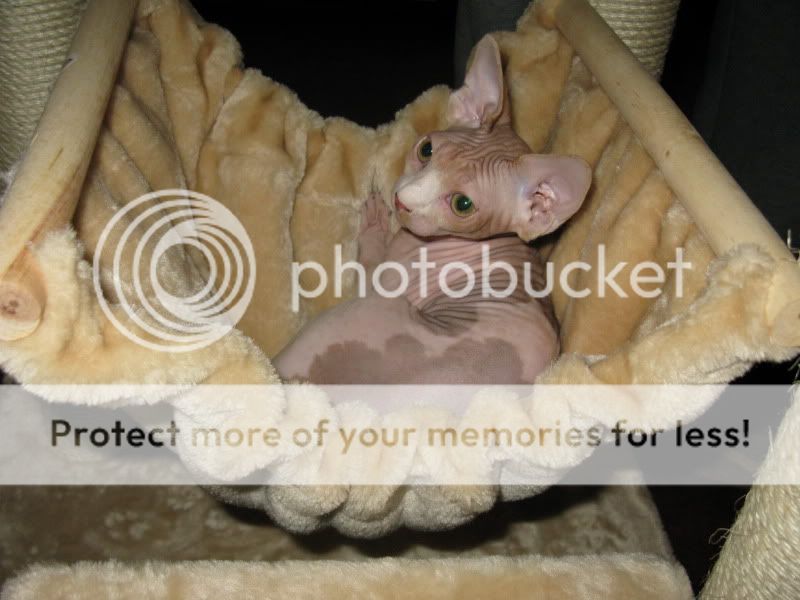
Beautiful Baby!Good idea for a thread...that being said, can anyone tell me what Lilo is?




- Joined
- Feb 24, 2011
- Messages
- 763
- Points
- 138
This is great! My breeder explained to me that points will always have blue eyes and a mink will have aqua eyes.... also a white will be bright white and a cream will be a peachy color. Tabby and tux are patterns. Many domestic cats are tabby and in general persians, rag dolls and siamese have points and blue eyes.
Mine are far too young to tell real color yet but Diggs is a chocolate tabby mink, although I.can't see his stripes.... and his eyes haven't changed.....
Oz is a green eyed white, he will get brighter as he grows
And Lyle is a lilac or lavender and white.... the breeder doesn't know what he will look like though, I believe this is the momas first litter, mom is lilac and white mink and dad is an odd eye white.
All of the boys have the same daddy, Oz and Diggs are from the same litter.
Oh my goodness, look at all those babies. Almost like having triplets

- Joined
- Apr 1, 2011
- Messages
- 5,411
- Points
- 393
Ok I did some research and them confirmed with my breeder. In order to get chocolate or lilacs both parents must carry the chocolate gene. White is a dominant gene and chocolate is not so in Diggs and Ozs litter there were 4 or 5 whites (dad is white), all had blue eyes but Oz who has green and Diggs is chocolate with aqua eyes, (mom is mink) he is tabby cuz at least 1 of his parents carries the gene. Lyle is lilac because mom is and carries the gene as well as dad..... he is mink because mom is mink (not really sure on eye color genetics)... I found a webpage that went into great detail about genetics and stuff I will try to find it and post it...